

Wildlife & Nature
Sinkholes, springs & wetland birdlife
The best wildlife & nature in Limestone Coast
Crystalline freshwater springs, mirror-still sinkholes, ancient cave systems and internationally significant wetlands make the Limestone Coast a natural wonderland - and a haven for birds, bats and rare aquatic life.
Read our guide to wildlife & nature ↓Browse wildlife & nature by area
Map shows the 24 places on this page.
Admella Discovery Trail
View →A coastal heritage trail commemorating the 1859 wreck of the SS Admella, one of Australia's worst maritime disasters.
Alexandra Cave
View →Naracoorte's prettiest chambers
The most beautifully decorated of Naracoorte's show caves: a 30-minute guided tour through three chambers of stalactites, columns and mirror-still pools.
Beachport Conservation Park
View →A coastal park of dunes, salt lakes and surf beaches wrapping around the town of Beachport.
Blanche Cave $$
View →One of Naracoorte's grand show caves, with vast chambers, fossil deposits and a long history of public tours.
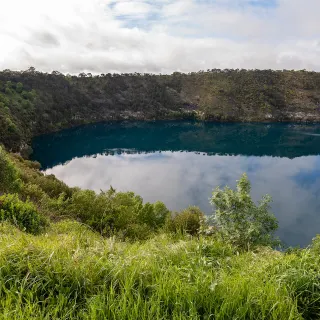
Blue Lake
View →The cobalt crater lake
A volcanic crater lake that turns a vivid cobalt blue each summer, ringed by a 3.6km walking and cycling track.
Blue Lake Pumping Station
View →Historic waterworks drawing the city's drinking water from the Blue Lake.
Bool Lagoon Game Reserve Free
View →A wetland of international importance
A vast Ramsar-listed wetland system south-west of Naracoorte, one of the most important waterbird breeding sites in southern Australia.
Bowman Scenic Drive $
View →A spectacular coastal drive south of Beachport, hugging limestone cliffs above the wild Southern Ocean.
Brownes Lake
View →The quiet fourth lake in the Mount Gambier volcanic complex.
Butcher Gap Conservation Park
View →Wetlands and birdlife minutes from Kingston
A 180-hectare mosaic of seasonal wetlands and coastal scrub 6 km south of Kingston SE, with an easy interpretive loop walk and outstanding birdwatching.
Canunda National Park
View →A wild coastal park of towering dunes, surf beaches and rugged cliffs stretching between Southend and Carpenter Rocks.
Cape Banks Lighthouse Free
View →A lighthouse on a wild coast
A skeletal steel lighthouse on a remote, wreck-strewn stretch of coast near Carpenter Rocks, watching over reefs that claimed many ships.
Cape Buffon Walk (Southend)
View →Canunda's clifftop circuit
An easy 2.5 km loop at the northern end of Canunda National Park, tracing limestone cliffs, sea stacks and lookouts above Rivoli Bay at Southend.
Cape Jaffa $
View →A small fishing settlement and marina south of Kingston, the gateway to the wild Cape Jaffa coast.
Cape Northumberland
View →South Australia's southernmost point, a windswept cape near Port MacDonnell with a lighthouse, blowholes and a little penguin colony.
Cave Garden (Thugi) Free
View →A cave in the city centre
A dramatic limestone sinkhole and waterfall in the heart of Mount Gambier, of deep cultural significance to the Boandik people.
Crater Lakes Walk
View →A loop trail around the rims of the Blue Lake and Valley Lake craters, taking in lookouts over the volcanic landscape.
Dingley Dell Conservation Park
View →The restored cottage home of bush poet Adam Lindsay Gordon, set in a small coastal conservation park.
Donovans Landing
View →A river hideaway on the Glenelg
A tiny settlement on the South Australian bank of the Glenelg River near the Victorian border, loved for fishing, canoeing and lazy riverside picnics.
Engelbrecht Cave $$
View →A cave beneath the streets
A guided show cave winding beneath the streets of Mount Gambier, popular with cave divers exploring its flooded passages.
Ewens Ponds Conservation Park
View →Drift-snorkel three spring pools
Three interconnected freshwater spring ponds of extraordinary clarity, linked by channels you can drift-snorkel through.
Geltwood Beach
View →Wild 4WD beach in Canunda named for a famous shipwreck.
Germein Reserve
View →Boardwalks through rare remnant wetland
A 55-hectare community-managed wetland reserve at Port MacDonnell, with five short walking trails, a boardwalk, frogs, wallabies and rich birdlife.
Hells Hole
View →A deep, flooded sinkhole hidden in pine forest near Mount Gambier, a well-known cave diving site.
About wildlife & nature in Limestone Coast
The Limestone Coast sits on a vast bed of limestone, and water shapes nearly all of its natural wonders. Crystal-clear springs at Piccaninnie Ponds and Ewens Ponds draw snorkellers and cave divers from around the world, while the cobalt Blue Lake and the cascading ferns of Umpherston Sinkhole reveal the volcanic side of the region.
Wildlife thrives in the wetlands and parks. Bool Lagoon and the lakes around Naracoorte host tens of thousands of waterbirds, and the Naracoorte Caves preserve a World Heritage fossil record of Australia's vanished megafauna. Along the coast, Little Dip Conservation Park shelters kangaroos, emus and seabirds among its dunes and lakes.
Much of this nature is accessible on short, well-marked walks and boardwalks, making it ideal for families and casual visitors. Dawn and dusk are the best times for spotting wildlife, and the cooler months bring peak birdlife to the wetlands.
Wildlife & Nature in Limestone Coast - frequently asked questions
What is the Limestone Coast known for when it comes to wildlife and nature?
The region sits on a vast bed of limestone, so water shapes nearly all of its natural wonders - crystal-clear freshwater springs, mirror-still sinkholes, ancient cave systems and internationally significant wetlands. Its headline attractions are the World Heritage-listed Naracoorte Caves, the cobalt Blue Lake at Mount Gambier, and the spring-fed snorkelling sites at Piccaninnie Ponds and Ewens Ponds. It is also a haven for birds, bats and rare aquatic life found almost nowhere else.
Why does Mount Gambier's Blue Lake change colour, and when is the best time to see it?
Each November the Blue Lake shifts from a dull steel-grey to a vivid cobalt blue, gradually fading again from late February into March. The change is driven by warmer surface water in summer causing tiny calcium carbonate crystals to form, which scatter blue light. The best time to see it at its most intense is between November and March.
Do I need a permit or booking to snorkel at Piccaninnie Ponds or Ewens Ponds?
Yes - both spring-fed sites require a permit to enter the water, available on a single-visit or annual basis, and you should book your snorkel or dive session before arriving. Cave diving at Piccaninnie Ponds is more restricted and only open to current Cave Divers Association of Australia members rated for sinkhole diving. Water access can also be temporarily closed, so always check the official Parks SA website before you travel.
What can I see at Naracoorte Caves, and do I need to book a tour?
Naracoorte Caves is South Australia's only World Heritage-listed site, famous for fossil deposits spanning around 500,000 years, including megafauna such as the Diprotodon and marsupial lion, plus a breeding colony of the critically endangered southern bent-wing bat. Entry to the park is free but guided cave tours, such as Victoria Fossil Cave and the family-friendly Alexandra Cave, carry a fee. Tours can sell out, so booking online in advance is recommended.
Where is the best birdwatching on the Limestone Coast?
Bool Lagoon Game Reserve, near Naracoorte, is the standout - a Ramsar-listed wetland of international importance that hosts the largest ibis rookery in South Australia and is visited by up to 150 bird species, with boardwalks and bird hides for easy viewing. The best birding is generally during and after the winter-spring flooding, when the lagoon is full and birds are nesting. Coastal Canunda National Park is also good for spotting kangaroos, emus and seabirds.